Gold has held purchasing power across millennia. Bitcoin has existed for barely over a decade and a half. Yet both are routinely described with the same phrase — "store of value" — and both attract a similar kind of holder: someone hedging against the idea that cash alone won't preserve their wealth. Comparing how each actually performs on purchasing power is more revealing than comparing their price charts.
The core similarity: scarcity
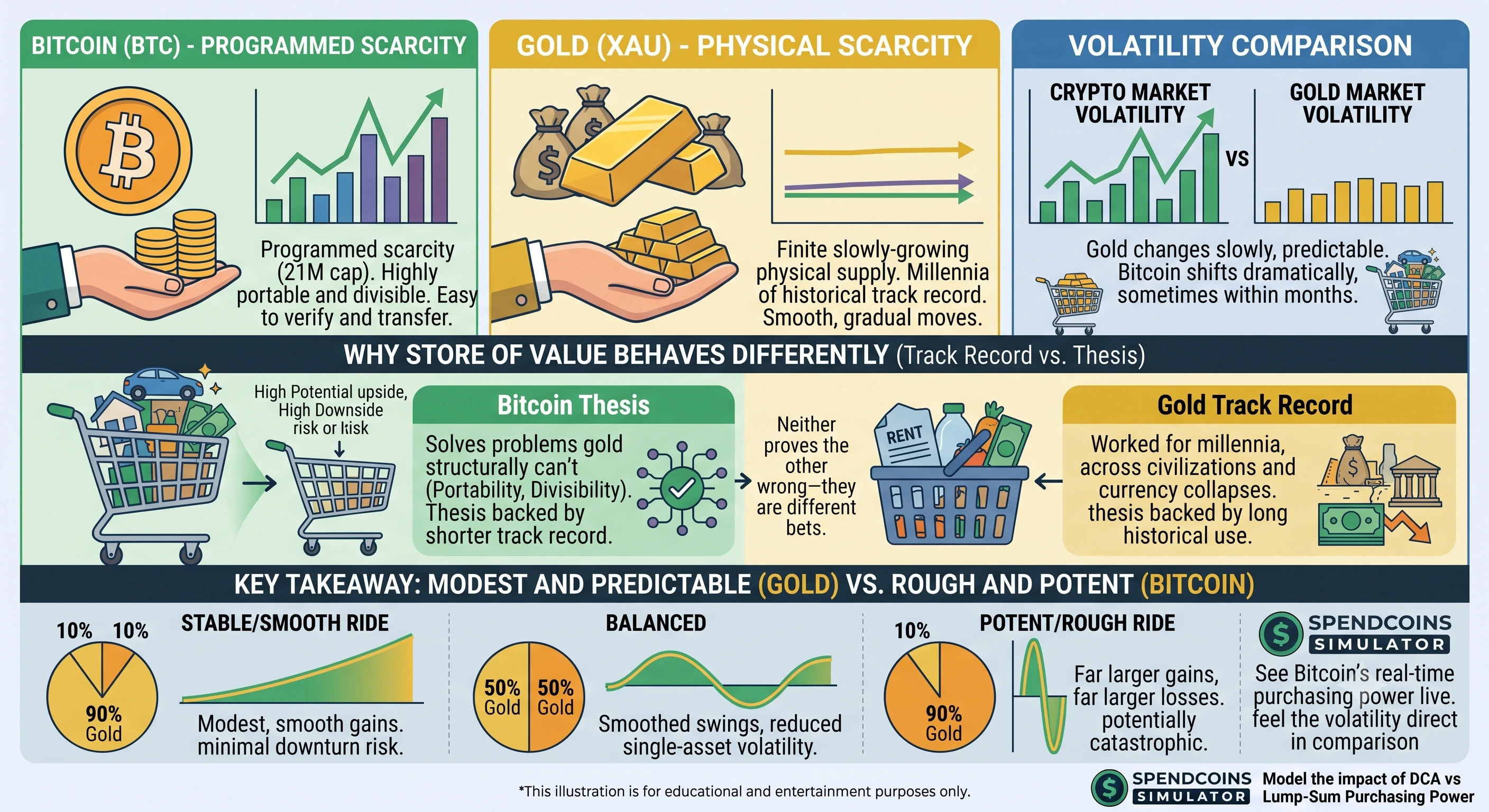
Gold's purchasing-power case rests on physical scarcity — there's a finite, slowly-growing supply that's expensive to increase quickly. Bitcoin's case rests on programmed scarcity — a hard cap of 21 million coins, enforced by code rather than geology. Both assets lean on the same basic argument: an asset that can't be arbitrarily created can't be arbitrarily devalued the way a currency can be through printing.
Where they diverge sharply: volatility
This is the single biggest practical difference for anyone thinking about purchasing power day to day. Gold's price moves are famously slow and boring by comparison — it can go years without a dramatic swing in either direction. Bitcoin's volatility, by contrast, can move that much in a single week. That means gold's purchasing power erodes or grows gradually and predictably, while Bitcoin's purchasing power can shift by an entire "shopping tier" almost overnight.
Track record vs. thesis
Gold's purchasing-power case is backed by thousands of years of historical use as money and a store of value across dozens of civilizations and currency collapses. Bitcoin's case is backed by a much shorter track record but a fundamentally different thesis: it's designed to be more portable, more divisible, and easier to verify and transfer than physical gold, at the cost of a much shorter history and much higher volatility.
Neither track record proves the other wrong — they're simply different bets. Gold's case is "this has worked for millennia." Bitcoin's case is "this solves problems gold structurally can't, and the market is still discovering its long-run value."
See Bitcoin's Purchasing Power Live
Experience real-time volatility framing directly through simulated shopping carts.
Start Simulation →What this means for purchasing power specifically
If you held a fixed dollar amount of each asset over the same multi-year window:
- Gold: Would have given you a smoother, more predictable ride — modest purchasing-power gains in inflationary periods, without dramatic single-year swings.
- Bitcoin: Would have given you a much rougher ride — potentially far larger purchasing-power gains during bull cycles, and far larger purchasing-power losses during corrections, sometimes within the same calendar year.
Framed as a shopping cart: gold's cart size changes slowly, a little at a time. Bitcoin's cart size can double or halve within months.
Complementary, not necessarily competing
Many investors who hold both don't treat it as an either/or choice — they treat gold as the "slow and steady" store-of-value allocation and Bitcoin as the higher-risk, higher-potential-reward one. Understanding the very different purchasing-power behavior of each, rather than just their shared "store of value" label, is what actually informs how much of each someone might be comfortable holding.