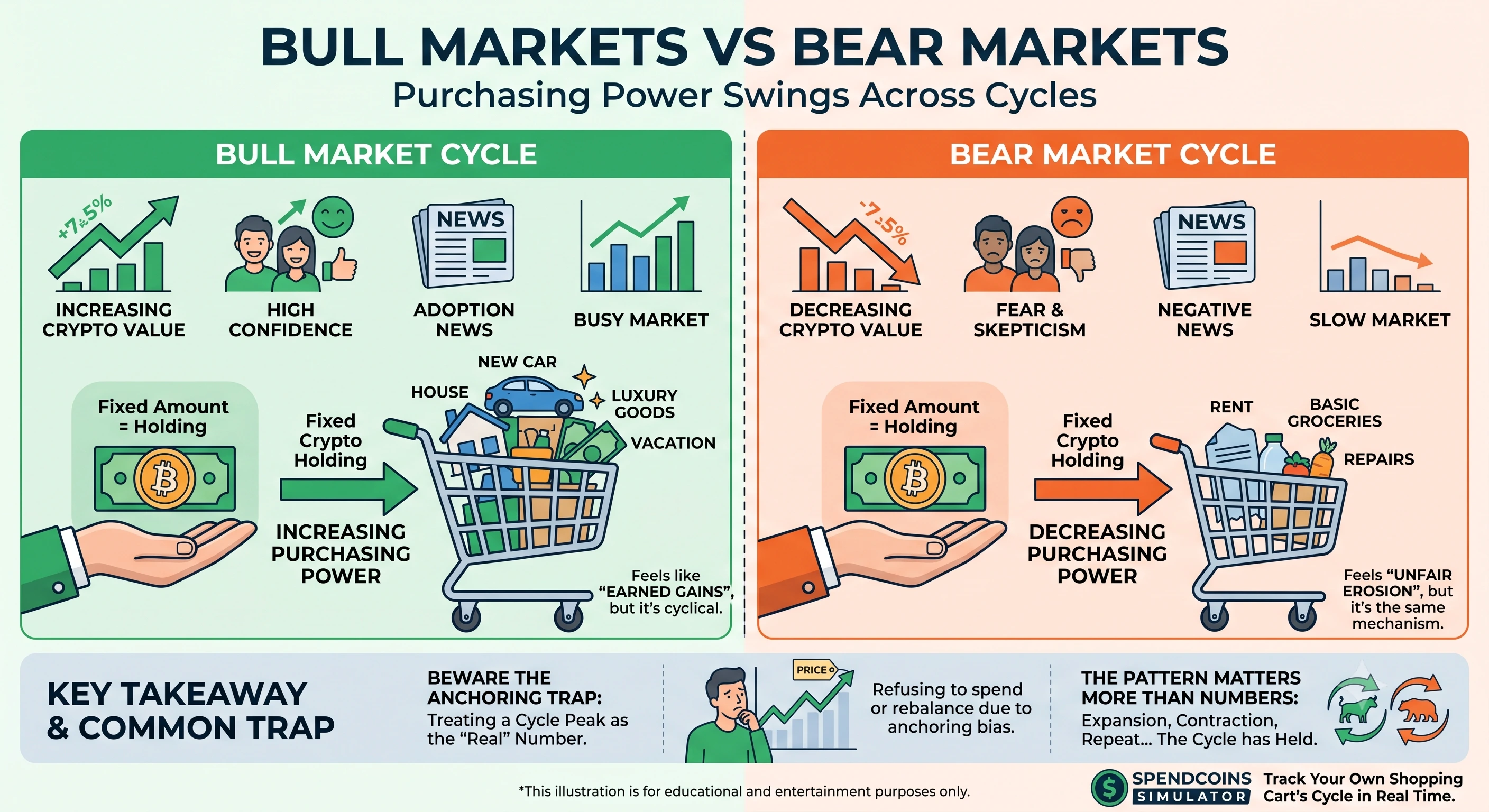
Crypto markets move in recognizable phases — sustained climbs (bull markets) and sustained declines (bear markets) — and each phase reshapes what a fixed crypto holding can actually buy, often dramatically. Understanding this rhythm is one of the most useful things a holder can internalize, because it reframes purchasing power as something cyclical rather than fixed.
What defines each phase
A bull market is a sustained period of rising prices, usually accompanied by growing optimism, increasing adoption headlines, and rising trading volume. A bear market is the mirror image — sustained declines, often accompanied by negative sentiment, reduced trading activity, and skepticism about the asset class as a whole. Crypto's history has moved through several full cycles of both since Bitcoin's creation.
How purchasing power behaves in a bull market
During a bull run, the same fixed coin holding buys progressively more as the cycle progresses. This creates a psychological effect worth naming honestly: purchasing power gains during a bull market tend to feel earned even though the holder did nothing differently — they simply held through a period of rising prices. That feeling can lead to overconfidence about the permanence of a purchasing-power tier reached at a cycle peak.
How purchasing power behaves in a bear market
During a downturn, the same coin holding buys progressively less, sometimes severely so. Bear markets have historically erased 70-80% of peak valuations for major cryptocurrencies during past cycles — meaning a holding that covered a house down payment at the top of a cycle might only cover a portion of a car by the bottom. This is the flip side of the bull-market feeling: the erosion tends to feel undeserved or unfair, even though it's the same mechanism running in reverse.
Track Your Portfolio Across Cycles
See how live market moves expand or contract your simulated shopping cart in real time.
Start Simulation →The trap: treating a cycle peak as the "real" number
One of the most common and costly mistakes in purchasing-power thinking is anchoring to the highest point a holding ever reached and treating any level below that as a "loss," even if the current level still represents solid appreciation from an earlier entry point. This is a well-documented behavioral bias — people weigh losses (relative to a recent peak) more heavily than equivalent gains, which can lead to poor decisions like refusing to spend or rebalance a holding that's still objectively valuable, simply because it's "down" from its peak.
Why the pattern matters more than the specific numbers
Whether or not any particular past cycle repeats exactly, the underlying pattern — expansion, contraction, repeat — has held across every major crypto cycle to date. Building a mental model around that pattern (rather than around any single price target) tends to produce steadier decision-making than reacting purely to whatever the current headline number is.
Watching a cycle happen in real time
Purchasing power during a bull or bear phase isn't something you can fully grasp from a history lesson — it's better felt by tracking a fixed holding's real-world shopping power over weeks or months as the market moves. The SpendCoins simulator makes that tracking simple: lock in an amount, check back periodically, and watch your own shopping cart expand or contract with the cycle.