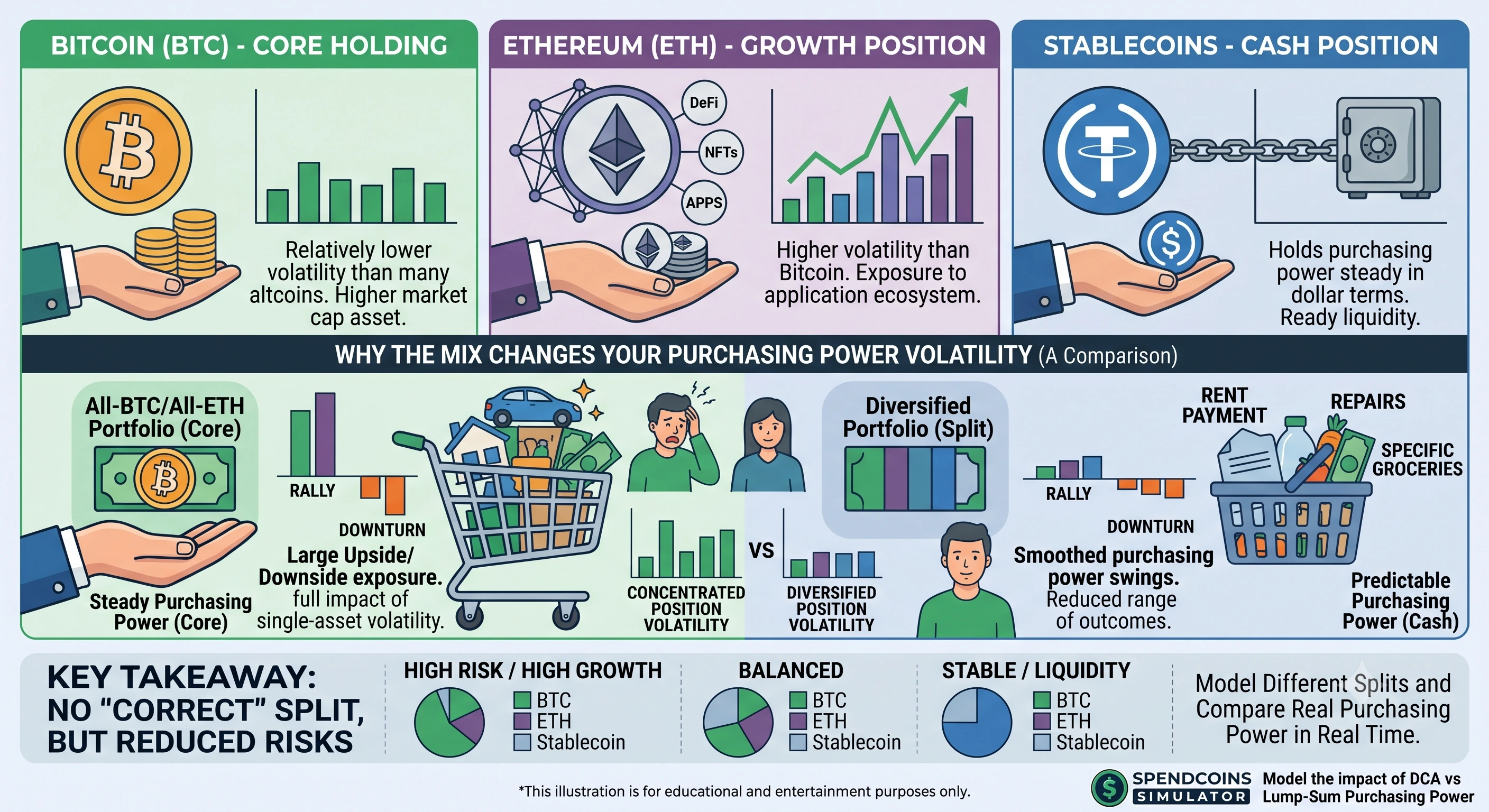
Holding a single cryptocurrency exposes a portfolio to that asset's full volatility, for better and worse. Splitting a holding across multiple assets — a basic diversification strategy — changes the shape of purchasing-power swings in ways worth understanding concretely before deciding how to allocate.
What each piece typically contributes
Bitcoin tends to anchor a crypto portfolio as the relatively lower-volatility, higher-market-cap asset — the closest thing crypto has to a "core holding," even though it's still far more volatile than traditional core holdings like bonds.
Ethereum adds exposure to the broader application ecosystem — DeFi, NFTs, and whatever the next wave of on-chain activity turns out to be — typically with somewhat higher volatility than Bitcoin, but a different set of growth drivers.
Stablecoins (cryptocurrencies pegged to a stable asset, usually the US dollar) serve a completely different purpose: they hold purchasing power steady in dollar terms, functioning as a "cash position" within a crypto portfolio rather than a growth position.
Why the mix changes your purchasing-power volatility
A portfolio split evenly across these three behaves very differently from a portfolio concentrated in just one. During a sharp downturn, an all-Bitcoin or all-Ethereum portfolio takes the full purchasing-power hit; a portfolio with a meaningful stablecoin allocation only takes that hit on the non-stable portion, meaning the overall purchasing-power decline is smaller in percentage terms. The trade-off, naturally, is that the same stablecoin portion also doesn't participate in the upside during a rally.
A simple purchasing-power comparison
Consider $30,000 split three ways: $10,000 in BTC, $10,000 in ETH, $10,000 in stablecoins, versus the same $30,000 held entirely in BTC. During a sharp market downturn, the diversified portfolio's purchasing power declines by roughly two-thirds of what the all-BTC portfolio experiences, purely because a third of the money wasn't exposed to the drop in the first place. During a strong rally, the diversified portfolio's purchasing-power gains are correspondingly smaller than the all-BTC portfolio's, for the same reason in reverse.
Simulate Different Allocations
See how a concentrated vs. a split crypto position translates into real-world buying power.
Start Simulation →Why some holders keep a stablecoin allocation specifically
Beyond smoothing volatility, a stablecoin position serves a practical purpose: it's readily available purchasing power that doesn't need to be converted (and doesn't carry the timing risk of converting) during a moment when a real-world purchase or opportunity comes up. Holders who want to be able to act on a purchase decision without first needing to sell a volatile asset at whatever price it happens to be that day often keep a portion of their holdings stable specifically for this reason.
There's no universally "correct" split
The right allocation between growth assets and stable ones depends entirely on an individual's risk tolerance, time horizon, and need for accessible purchasing power — there's no single ratio that fits every situation. What diversification does reliably do is reduce the range of possible purchasing-power outcomes compared to a concentrated position, in both directions.
Model different splits yourself
The SpendCoins simulator lets you enter amounts in different assets separately — a useful way to compare how a concentrated BTC position and a split BTC/ETH position would each translate into real-world purchasing power at today's prices.