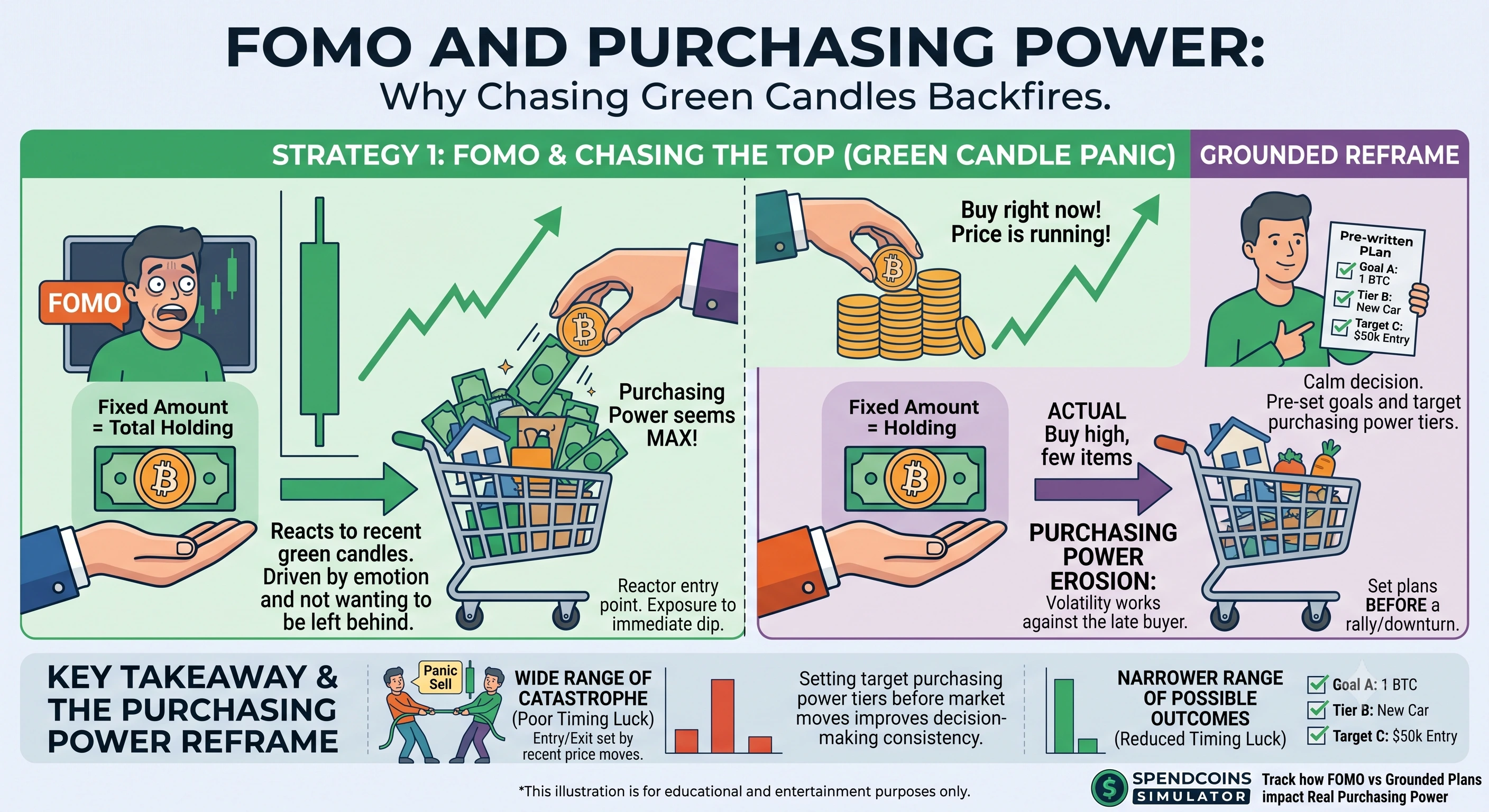
"FOMO" — fear of missing out — is one of the most consistently destructive forces in crypto markets, and it operates directly through purchasing-power psychology. Understanding exactly how it distorts decision-making is one of the more practically useful things a crypto holder can learn.
What FOMO actually does to your thinking
FOMO kicks in when an asset's price is rising sharply and visibly — a "green candle" streak — and the fear of missing further gains starts to override normal risk assessment. The purchasing-power version of this feeling is specific: watching other people's holdings buy more and more, day after day, while yours sits on the sidelines in cash, creates a strong emotional pull to buy in right now, regardless of whether the price has already run up significantly.
The mechanical problem with buying during FOMO
The issue isn't emotional alone — it's mathematical. FOMO-driven buying, almost by definition, happens after a price has already risen substantially, meaning the buyer is purchasing at a worse (higher) price than the purchasing-power gains they were reacting to in the first place. The purchasing power that looked so appealing from the outside was largely already captured by people who bought earlier — the FOMO buyer is often stepping in near the top of a short-term move, right before the volatility that made the asset attractive in the first place works in the opposite direction.
Why this pattern repeats despite being well known
Even experienced market participants aren't immune to FOMO, because the psychological trigger — watching a purchasing-power gain happen to someone else while you're not participating — is a strong, universal human response, not a knowledge gap. Knowing intellectually that "buying after a big rally is often a bad entry point" doesn't fully protect against the emotional pull when it's actually happening in real time.
Test Your Psychological Reaction
Watch how live green candles shift simulated purchasing power without risking real capital.
Start Simulation →The purchasing-power reframe that helps
One practical mental tool: before buying during a sharp rally, ask specifically what purchasing-power tier you're trying to reach, and whether that tier is meaningfully different from where you already are. Often, the honest answer is that the FOMO isn't really about a specific goal — it's about not wanting to feel left behind, which is a much weaker basis for a financial decision than a concrete purchasing-power target.
The mirror-image mistake: panic selling
FOMO's counterpart — panic selling during a sharp downturn, driven by the same emotional intensity in reverse — causes a similar mechanical problem: locking in a purchasing-power loss right before, historically, many downturns have partially or fully recovered. Both mistakes share the same root cause: reacting to a recent, emotionally vivid price move rather than a considered plan set in advance.
A more grounded approach
Setting purchasing-power targets and entry/exit plans before a rally or downturn happens — while emotions are neutral — tends to produce more consistent decision-making than trying to reason clearly in the middle of a fast-moving, emotionally charged market. It's far easier to make a calm decision on a quiet Tuesday than during a weekend when a coin is up 30% and every timeline is full of excitement.
Practice noticing the pull
The SpendCoins simulator is a low-stakes way to notice this feeling without real money on the line — watch how a live price rally shifts purchasing power, and pay attention to whether it triggers an urge to "buy in" even in a purely hypothetical exercise. That's the same instinct that plays out with real money.