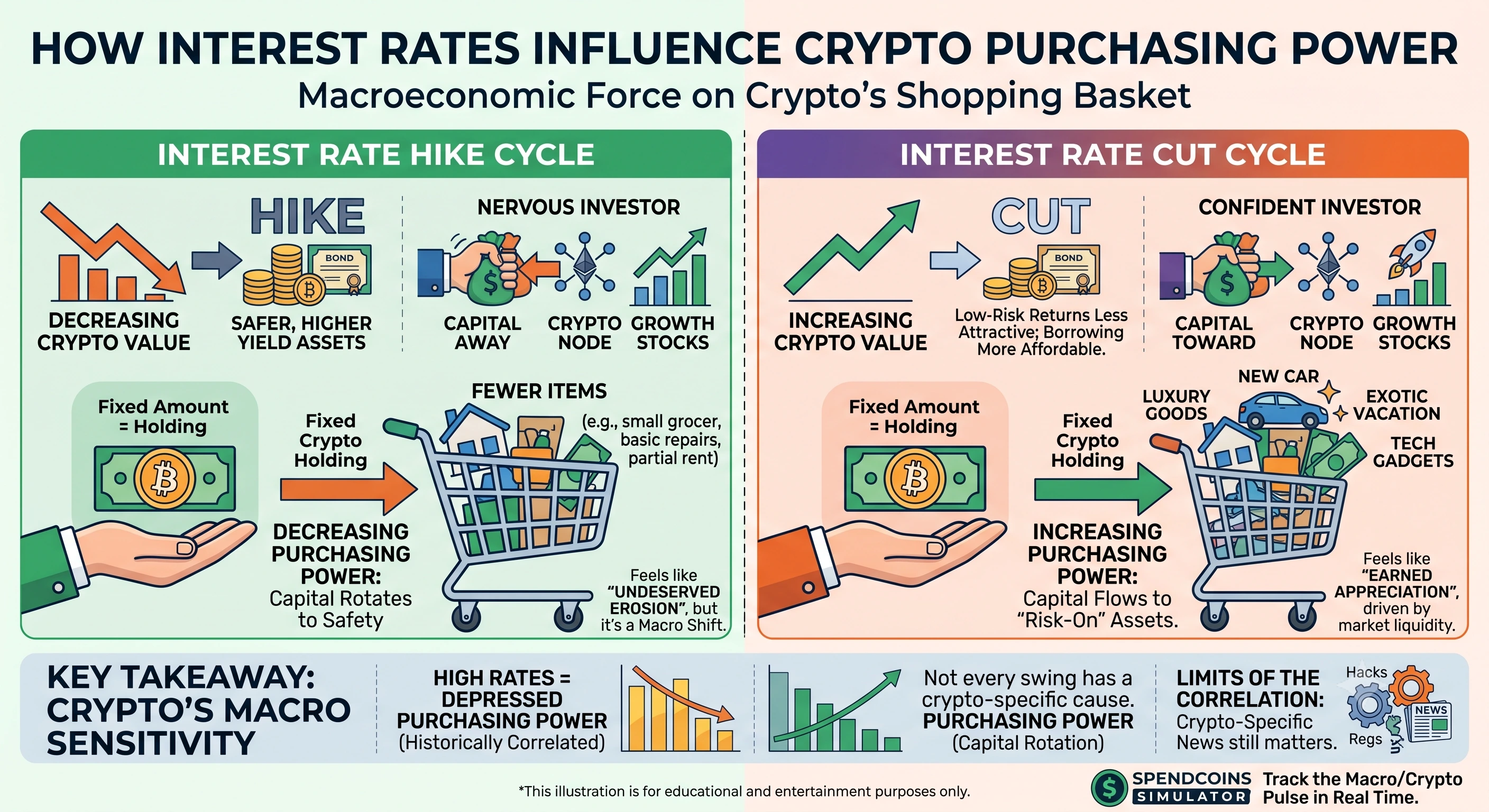
Crypto markets are often described as detached from traditional finance, but one macroeconomic force reliably moves them anyway: interest rate policy set by central banks, particularly the US Federal Reserve. Understanding this connection helps explain why crypto's purchasing power sometimes swings for reasons that have nothing to do with crypto news at all.
The basic mechanism
When central banks raise interest rates, borrowing money becomes more expensive and safer assets (like government bonds) start offering more attractive, low-risk returns. This tends to pull investment capital away from higher-risk assets — including growth stocks and cryptocurrency — because investors can get a decent return with far less risk elsewhere. When rates fall, the opposite tends to happen: safer assets offer less attractive returns, and capital tends to flow back toward higher-risk, higher-potential-reward assets like crypto.
Why crypto is especially sensitive to this cycle
Cryptocurrency is generally categorized as a "risk-on" asset — meaning it tends to attract capital when investors are feeling optimistic and willing to take on risk, and tends to lose capital when investors are feeling cautious and want safety. Interest rate changes are one of the strongest signals that shift investor sentiment between those two modes, which is part of why crypto prices — and by extension, purchasing power — have shown a noticeable historical correlation with rate-hike and rate-cut cycles.
A concrete purchasing-power example
Imagine holding a fixed amount of Bitcoin through a period where central banks are aggressively raising rates to fight inflation. Even with nothing crypto-specific happening — no hacks, no regulatory news, no technical developments — that holding's purchasing power can decline simply because capital is rotating toward safer, higher-yielding assets elsewhere in the financial system. The reverse is equally true: a rate-cutting cycle can boost purchasing power for reasons that have nothing to do with crypto adoption or technology.
Watch Macro Moves in Real Time
See how global rate shifts change your simulated shopping power on live market data.
Start Simulation →Why this matters for how you interpret price moves
This connection is a useful mental check against over-explaining crypto price action. Not every purchasing-power swing has a crypto-specific cause — sometimes a decline (or a rally) is really a macro story about interest rates and where global capital is choosing to sit, playing out through crypto prices rather than being caused by crypto itself.
The limits of this relationship
It's worth being careful not to overstate the correlation — crypto markets also move on crypto-specific news (regulatory shifts, major hacks, network upgrades, adoption milestones) that has nothing to do with interest rates, and the strength of the rate-crypto relationship has varied across different periods. Treating interest rates as one input among several, rather than the sole explanation for every price move, is the more accurate way to think about it.
Keep an eye on both
The most useful habit for anyone tracking crypto purchasing power isn't to ignore macro news in favor of crypto-specific news, or vice versa — it's to notice when a price move coincides with a major rate decision and ask whether that's a plausible driver, alongside whatever else is happening in the crypto world specifically.
Watch it play out
The SpendCoins simulator reflects live prices, which means it also reflects whatever macro forces — including interest rate expectations — are currently moving the market. Checking it around major central bank announcements is a useful way to see this dynamic in action.