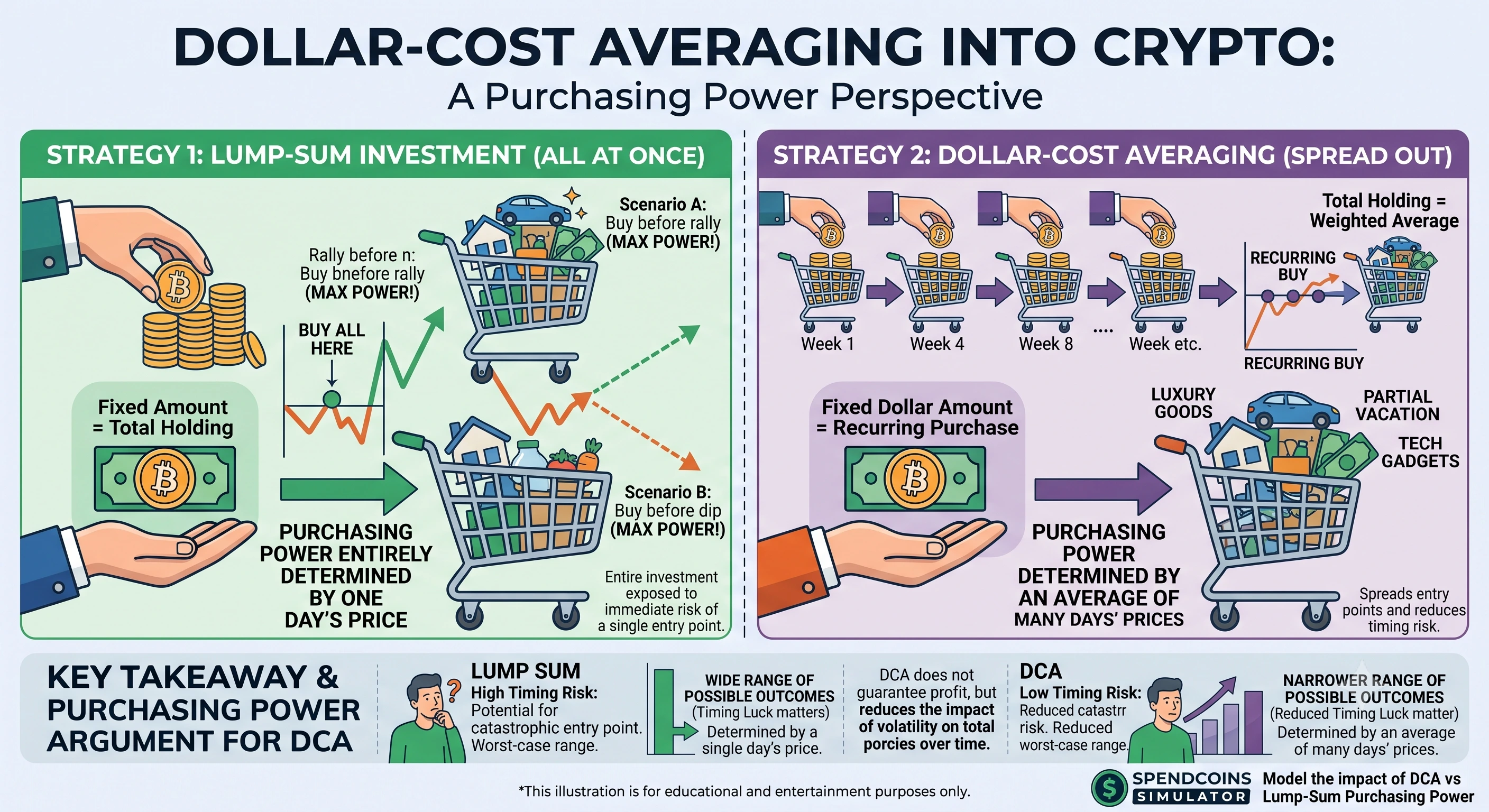
One of the most common questions from anyone starting to hold cryptocurrency is timing: buy all at once, or spread purchases out over time? The strategy of spreading purchases out — known as dollar-cost averaging, or DCA — is widely recommended for volatile assets, and the purchasing-power lens explains exactly why.
What dollar-cost averaging actually means
Instead of converting a lump sum into crypto on a single day, DCA means investing a fixed dollar amount at regular intervals — weekly or monthly, for example — regardless of what the price happens to be doing on any given day. Over time, this averages out the price you effectively paid per coin, rather than betting everything on a single moment.
Why timing matters so much with volatile assets
Earlier purchasing-power comparisons on this site have shown just how much a single day's price move can shift what a fixed crypto holding buys. That volatility cuts both ways for a lump-sum investor: buy right before a dip, and your purchasing power takes an immediate hit; buy right before a rally, and it jumps. DCA is specifically designed to reduce the impact of that single-moment luck by spreading the "entry price" across many different days, some higher, some lower.
The purchasing-power argument for DCA
Think of it this way: a lump-sum buyer's purchasing power is entirely determined by the price on one specific day. A DCA buyer's purchasing power is determined by an average of many days' prices — which smooths out both the best-case and worst-case scenarios. This doesn't guarantee a better outcome than lump-summing (if prices rise steadily, lump-summing early actually wins), but it substantially reduces the range of possible outcomes, which is exactly the kind of risk reduction that matters most for volatile assets.
Test Different Entry Points
See how simulated shopping power changes when entering hypothetical amounts on different market days.
Start Simulation →The trade-off worth being honest about
DCA isn't a way to avoid volatility risk entirely — it's a way to reduce timing risk specifically. If a volatile asset trends strongly upward over your DCA period, a lump-sum purchase made on day one would have outperformed spreading purchases out, because you'd have bought more coins before the price rose. DCA's benefit isn't "better average outcomes" — it's "fewer catastrophic worst-case outcomes," which is a different, more risk-focused goal.
A useful mental model
Picture two purchasing-power outcomes: someone who lump-summed right before a sharp downturn, and someone who DCA'd through the same period. The lump-sum buyer's purchasing power took the full hit immediately. The DCA buyer's purchasing power took a smaller hit on average, because only a portion of their total investment was exposed to that specific bad entry point — the rest was invested at various other prices, some better, some worse.
Try modeling it yourself
You don't need real money to understand the mechanic — enter a few different hypothetical amounts into the SpendCoins simulator on different days and compare the purchasing power each one produces. Watching the numbers shift day to day is the fastest way to build real intuition for why spreading out entry points reduces the range of outcomes.