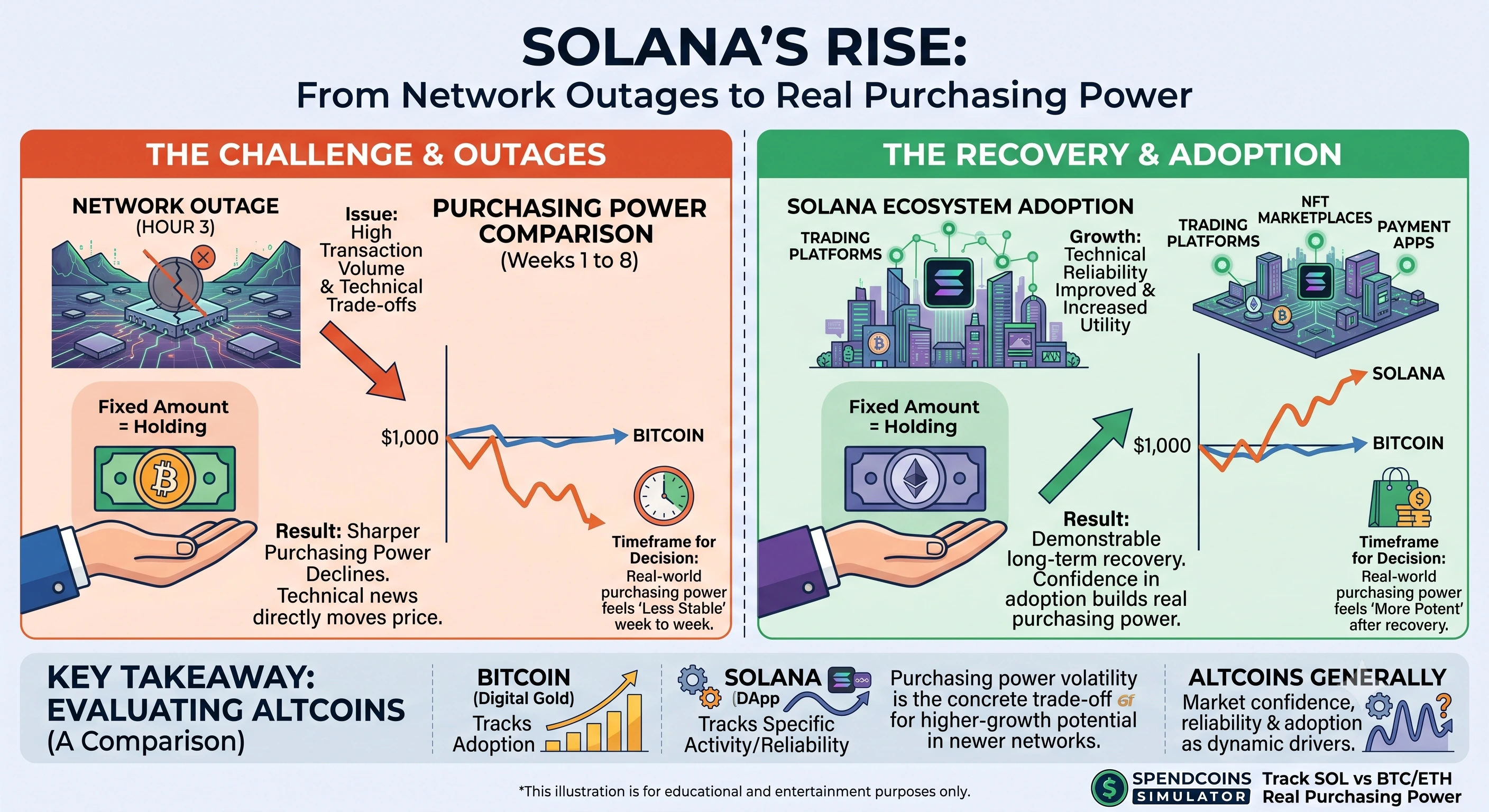
Few major cryptocurrencies have had as bumpy a public reputation as Solana — a project that's simultaneously known for being one of the fastest, cheapest blockchains to transact on, and for a string of high-profile network outages that once made "Is Solana down again?" a running joke in crypto circles. Its purchasing-power journey reflects that tension directly.
What Solana was built to solve
Solana was designed around a core trade-off that most blockchains wrestle with: speed and cost versus decentralization. Its architecture prioritizes extremely fast transaction processing and very low fees compared to networks like Ethereum, which made it attractive for use cases needing high throughput — trading platforms, gaming applications, and payment-like use cases where waiting or paying high fees would be a dealbreaker.
The outages, and what they meant for purchasing power
Solana experienced several significant network outages in its early years, periods where the network stopped processing transactions entirely for hours at a time. Each outage triggered sharp, immediate purchasing-power declines — sometimes losing a large share of value within days — as confidence in the network's reliability took a hit. This is a useful case study in a purchasing-power lesson that applies beyond Solana specifically: for newer, higher-beta assets, technical news can move price and purchasing power just as sharply as market-wide sentiment does.
The recovery and why it happened
Despite the outages, Solana's ecosystem kept building — trading platforms, NFT marketplaces, and later a wave of new token launches all found a home on the network, partly because of its low fees, which made frequent small transactions economically viable in a way they aren't on more expensive networks. As reliability improved and adoption grew, Solana's purchasing power recovered and, at points, reached new highs — demonstrating that a rough early reputation doesn't necessarily cap an asset's long-term trajectory.
Compare SOL vs BTC & ETH
Check how Solana's purchasing power holds up against major crypto assets in real time.
Start Simulation →What this means for how you evaluate altcoins generally
Solana's story is a useful reminder that a newer cryptocurrency's price — and therefore its purchasing power — often reflects a market's evolving confidence in its reliability and adoption, not just abstract speculation. Positive technical developments (successful upgrades, growing developer activity) and negative ones (outages, security incidents) both move purchasing power directly and often faster than similar news would move a more established asset like Bitcoin.
The volatility trade-off, made concrete
A fixed dollar amount held in Solana has historically experienced sharper purchasing-power swings — in both directions — than the same amount held in Bitcoin. That's the practical cost of the higher-growth-potential, higher-risk profile that comes with newer, less-established networks: the same $10,000 position might buy a noticeably different "tier" of goods week to week in a way a comparable Bitcoin position typically wouldn't.
Check Solana's current standing
Prices and purchasing power shift constantly, so the most accurate way to see where Solana stands today is live. Enter an amount into the SpendCoins simulator and compare SOL against BTC and ETH to see the current gap.